5.2 Alternative Forms
Consider first a planar surface y = 0. Following Karp and Karl (1965), a logical extension of the first order conditions (2.23) and (2.25) to the second order is
| (5.1) |  |
for some ? m and  , or equivalently
| (5.2) |  |
and although we can obviously choose a 0 =  = 1, it is more convenient not to do so. For the incident plane wave
| (5.3) |  |
the corresponding reflection coefficients are
| (5.4) |  |
and
| (5.5) |  |
The boundary condition for E y can be written as
where
| (5.6) |  |
and using the wave equation we obtain
| (5.7) |  |
For the component H y the analogous result is
| (5.8) |  |
where
| (5.9) |  |
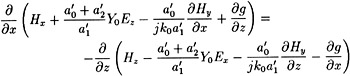
and now the only second derivatives are tangential ones. We can also express the conditions in terms of tangential field components. From Maxwell's equations and the fact that. ?. E = 0, (5.7) can be written as
| (5.10) | 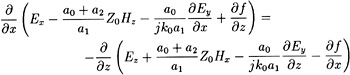 |
for any function f = f( x, z). Similarly, from (5.8),
for any function g = g( x, z), and therefore
| (5.11) | 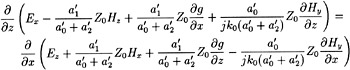 |
Choose
Then if
| (5.12) | 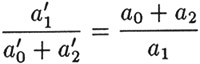 |
so that
| (5.13) | 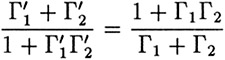 |
(5.10) and (5.11) imply
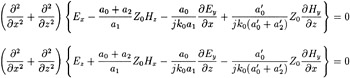
and by the same argument as that used in Section 2.3, we obtain
| (5.14) | 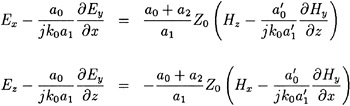 |
on y = 0+. Hence (Senior and Volakis, 1989)
| (5.15) |  |
which can also be written as
| (5.16) |  |
Provided the coefficients satisfy (5.12), the condition (5.15) is equivalent to (5.1) and, as the above analysis shows, can be obtained from (5.1) by a process of tangential...


 TABLE OF CONTENTS