Plant Engineer's Reference Book, Second Edition

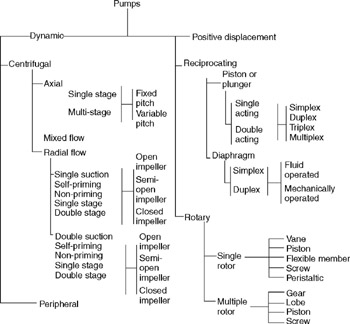
Pumps impart energy to the liquids being transferred by mechanical means using moving parts. They can be classified as rotodynamic or positive displacement. Roto-dynamic pumps cause continuous flow, and the flow rate and discharge pressure are effectively constant with time. Positive displacement pumps deliver fixed quantities at a rate determined by driving speed. The main types of pump commonly used are listed in Figure 20.1.
Pumps are used to transfer liquids, moving blood and other biological fluids, delivering measured quantities of chemicals as in dosing in water treatment, in firefight-ing, in irrigation, moving foods and beverages, pumping pharmaceutical and toilet products, in sewage systems, in solids transport, in water supply and in petrochemical and chemical plant. They are utilized in power transfer, braking systems, servomechanisms and control, as well as for site drainage, water-jet cutting, cleaning and descaling. Pumps thus give a wide range of pressure rises and flow rates with pumping liquids which vary widely in viscosity and constituency.
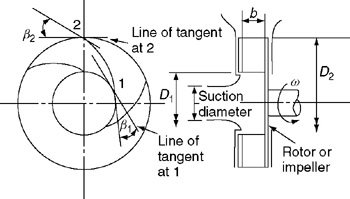
Taking a typical centrifugal pump (Figure 20.2) the Euler equation can be written, at best efficiency flow, in the form
where u 2 = ?D 2/2, A 2 = ?D 2 b 2, Q is flow rate and H is head rise. This ignores flow losses, so...