Plant Engineer's Reference Book, Second Edition

40.9: Gear Lubricants

40.9 Gear Lubricants

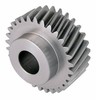
There are few engineering applications in which gears do not play an essential part. They can be used to reduce or increase speed, transmit power and change the direction or position of a rotating axis. There are several types of gears to suit these varying operational conditions, such as spur, helical, plain and spiral bevels, hypoid, worm and wheel (Figure 40.6).


Figure 40.6: Gear types

Figure 40.6: Gear types(continued)

Extremely high pressures are developed between meshing teeth as, in theory, they only have point or line contact. Together with the sliding between mating surfaces which is always present it is clear that, if there is metal-to-metal contact, rapid wear will occur. The function of the lubricant is to provide and maintain a separating film under all the variations in speed, load and temperature. It must also act as a coolant and protect the gears against corrosion.

The lubrication of gears is not a simple matter, because of their shape and variability of motion. Fundamental factors which affect their lubrication are gear characteristics, materials, temperature, speed, loading, method of applying the lubricant and environment.

40.9.1 Gear Characteristics

40.9.1.2 Spur, Bevel, Helical and Spiral Bevel gears

Providing the speed is sufficient and the load does not squeeze out the lubricant, the effect of rotating these gears is to produce a hydrodynamic wedge of a relatively thick lubricating film between the meshing surfaces. If the load is increased, the pressure within the contact zone increases, causing a reduction in film...

UNLIMITED FREE
ACCESS
TO THE WORLD'S BEST IDEAS

SUBMIT
Already a GlobalSpec user? Log in.

This is embarrasing...

An error occurred while processing the form. Please try again in a few minutes.

Customize Your GlobalSpec Experience

Category: Hypoid Gears
Finish!
Privacy Policy

This is embarrasing...

An error occurred while processing the form. Please try again in a few minutes.