Plant Engineer's Reference Book, Second Edition

Chapter 27: Noise and Vibration

Evan Davies,
MA, MIEH, DipInstAc, DMS
Team Manager, Pollution Control Group, Leicester City Council

27.1 Introduction to Basic Acoustics

Sound can be defined as the sensation caused by pressure variations in the air. For a pressure variation to be known as sound it must occur much more rapidly than those of barometric pressure and the degree of variation is much less than atmospheric pressure.

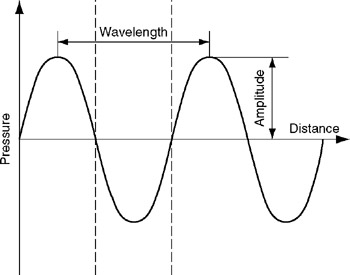
Audible sound has a frequency range of approximately 20 Hz to 20kHz and the pressure ranges from 20 10 -6 N/M to 200 N/M. A pure tone produces the simplest type of wave form, that of a sine wave (Figure 27.1). The average pressure fluctuation is zero, and measurements are thus made in terms of the root mean square (rms) of the pressure variation. For the sine wave the rms is 0.707 times the peak value.


Figure 27.1: Sine wave

Since rms pressure variations have to be measured in the range 20 10 -6 N/M to 200 N/M (a range of 10 7) it can be seen that an inconveniently large scale would have to be used if linear measurements were adopted. Additionally, it has been found that the ear responds to the intensity of a sound ( aP 2) in a logarithmic way. The unit that has been adopted takes these factors into account and relates the measured sound to a reference level. For convenience, this is taken as the minimum audible sound (i.e. 20 10 -6

UNLIMITED FREE
ACCESS
TO THE WORLD'S BEST IDEAS

SUBMIT
Already a GlobalSpec user? Log in.

This is embarrasing...

An error occurred while processing the form. Please try again in a few minutes.

Customize Your GlobalSpec Experience

Category: Audio Transducers and Buzzers
Finish!
Privacy Policy

This is embarrasing...

An error occurred while processing the form. Please try again in a few minutes.