Plant Engineer's Reference Book, Second Edition
Chapter 32: Heat Exchangers

M Ahmed B Lamb,
APV Systems

32.1 The APV Paraflow Heat Exchanger

While the original idea for the plate heat exchanger was patented in the latter half of the nineteenth century, the first commercially successful design was introduced in 1923 by Dr Richard Seligman, founder of APV. Initially, a number of cast gunmetal plates were enclosed within a frame in a manner quite similar to a filter press. The early 1930s, however, saw the introduction of plates pressed in thin-gauge stainless steel. While the basic design remains unchanged, continual refinements have boosted operating pressures from about 1 to 25 kgf/cm2 in current machines.

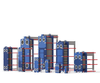
The APV Paraflow plate heat exchanger consists of a frame in which closely spaced metal plates are clamped between a head and follower. The plates have corner ports and are sealed by gaskets around the ports and along the plate edges. A double seal forms pockets open to atmosphere to prevent mixing of product and service liquids in the rare event of leakage past a gasket.

The plates are grouped into passes with each fluid being directed evenly between the paralleled passages in each pass. Whenever the thermal duty permits, it is desirable to use single-pass, counterflow (Figure 32.1) for an extremely efficient performance. Since the flow is pure counterflow, correction factors required on the Log Mean Temperature Difference (LMTD) approach unity. With all connections on the head of the unit, the follower is free for very quick access to cleaning and maintenance. The effect of multipass...

UNLIMITED FREE
ACCESS
TO THE WORLD'S BEST IDEAS

SUBMIT
Already a GlobalSpec user? Log in.

This is embarrasing...

An error occurred while processing the form. Please try again in a few minutes.

Customize Your GlobalSpec Experience

Category: Heat Exchangers
Finish!
Privacy Policy

This is embarrasing...

An error occurred while processing the form. Please try again in a few minutes.