Thermal Analysis of Polymeric Materials
Chapter 1: Atoms, Small, and Large Molecules

1.1 Microscopic Description of Matter and History of Polymer Science

1.1.1 History

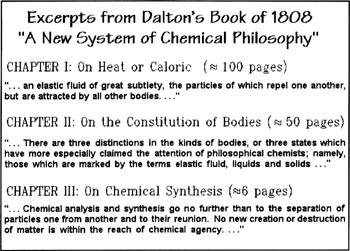
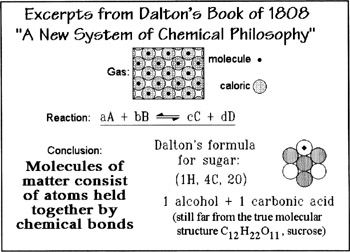
At the beginning of the 19 th century the description of matter attained, what one would call today, a scientific basis. Dalton [1] supported the atomic theory with experiments permitting the development of modern chemistry. The book "A New System of Chemical Philosophy," describes this new approach. In Fig. 1.1, an excerpt is displayed. Chapters I and II give a summary of the contemporary understanding of nature by analyzing heat and mass, the two basic building-blocks of any material. Chapter I displays the theory of the caloric as it was generally accepted in the early 19 th century. Heat was assumed to be an indestructible fluid that occupies spaces between the molecules of matter, as illustrated with the schematic at the top of Fig. 1.2 for gases. The schematic does not agree with today's picture of a gas which calls for mobile molecules that collide with each other (see Sect. 2.5.1). It, however, permitted quantitative measurements as discussed in more detail in the description of heat and temperature in Sect. 2.1.1.


Figure 1.1

Figure 1.2

Chapter II of Dalton's book gives a description of the three classical phases of matter in terms which we still recognize today, except that in modern science one calls the elastic fluids of the quotation in Fig. 1.1, gasses. Only Chap. III has stood the test of time and is the basis of the fame of Dalton: "Molecules...

UNLIMITED FREE
ACCESS
TO THE WORLD'S BEST IDEAS

SUBMIT
Already a GlobalSpec user? Log in.

This is embarrasing...

An error occurred while processing the form. Please try again in a few minutes.

Customize Your GlobalSpec Experience

Category: Nanomaterials
Finish!
Privacy Policy

This is embarrasing...

An error occurred while processing the form. Please try again in a few minutes.