The principle of heat-flux calorimetry is illustrated with a schematic of a classical DTA in Fig. A.9.1. The reference (Rfc) and sample (Spl) materials have immersed thermocouples for precise temperature measurement. An identical environment with a temperature that increases linearly in time is created by the DTA-furnace and a programmer. The furnace-control thermocouple checks the furnace (block) temperature, T b, against the program temperature. Any difference is used to adjust the power to the heater. Additional cooling may be introduced by placing the DTA furnace in a cold bath and regulating the heating. The symmetrically placed Rfc and Spl should have the same heat flux for the same temperature difference from the furnace T b - T r and T b - T s, making the temperature difference, ?T = T r - T s, proportional to the differential heat-flow rate, HF. The reference temperature for both thermocouples is provided by an ice bath (see Fig. 4.8). For higher precision one uses an automatic reference cell with Peltier cooling and heating that can establish the triple point of water to better than 0.01 K. Commercial instruments provide internal, electronic reference junctions.
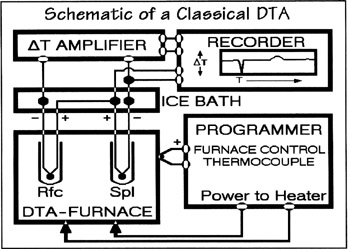 Figure A.9.1
 The thermocouple voltage due to ?T is only 1% or less than the voltage due to the absolute temperatures and must, thus, be preamplified before recording. Both ?T (proportional to heat flow HF), and T s are then recorded either directly, as illustrated in Fig. A.9.1,...
Copyright Springer-Verlag Berlin Heidelberg 2005 under license agreement with Books24x7


 TABLE OF CONTENTS