Thermal Analysis of Polymeric Materials

A major advance in differential scanning calorimetry is the application of temperature modulation, the topic of this section. The principle of measurement with temperature modulation is not new, the differential scanning technique, TMDSC, however, is. This technique involves the deconvolution of the heat-flow rate into one part that follows modulation, the reversing part, and one, that does not, the nonreversing part. The term reversing is used to distinguish the raw TMDSC data from data proven to be thermodynamically reversible. Reversing may mean the modulation amplitude bridges the temperature region of irreversibility or the modulation causes nonlinear or nonstationary effects, as will be discussed in Sects. 4.4.3 and 4. The first report about TMDSC was given in 1992 at the 10 th Metting of ICTAC [1] , [22], see also Fig. 2.5.
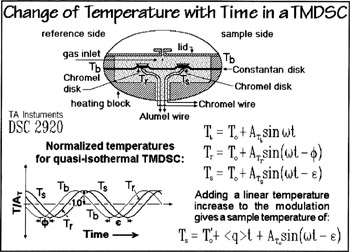
In principle, any DSC can be modulated. As the details of construction of the DSC equipment vary, it may be advantageous to modulate in different fashions. One can modulate the block, reference, or sample temperatures, as well as the temperature difference (proportional to the heat-flow rate). For example, the temperature modulation of the Mettler-Toledo ADSC is controlled by the block-temperature thermocouple (see Fig. 4.57), while the modulation of the MDSC of TA Instruments in Fig. 4.85 is controlled by the sample thermocouple. Of special interest, perhaps, would be a modulated dual cell as shown in Fig. 4.56.
In the following discussion, most calculations...