Thermal Analysis of Polymeric Materials

For this summary, forms of thermal analyses under extreme conditions are described for the measurement of heat and temperature, as dealt within Sects. 4.1 4. The distinction between DTA and DSC seen in these methods is described in Appendix 9. In Appendix 10, DTA or DSC at very low and high temperatures and DTA at very high pressures are mentioned. This is followed by a discussion of high-speed thermal analysis which, in some cases, may simply be thermometry. Finally, microcalorimetry is treated. One might expect that these techniques will develop in this century [1]. The numbers in brackets link to references at the end of this appendix.
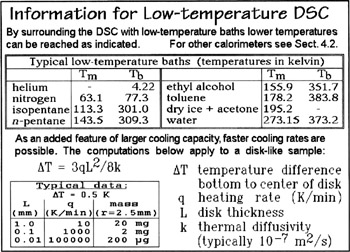
Low-temperature DTA and DSC needs special instrumentation [2]. In Fig. A.10.1 a list of coolants is given which may be used to start a measurement at a low temperature. From about 100 K, standard equipment can be used with liquid nitrogen as coolant. The next step down in temperature requires liquid helium as coolant. A differential, isoperibol, scanning calorimeter has been described for measurements on samples of 10 mg in the 3 to 300 K temperature range [3]. To reach even lower temperatures, especially below 1 K, one needs again another technique [4], but it is possible to make thermal measurements even at these temperatures. Usually heat capacities and thermal conductivities are obtained in this temperature range by time-dependent heat leak measurements.
High temperature and pressure DSC and DTA needs special materials for the construction...