The thermodynamic or kelvin scale gives an absolute temperature. The origin of the kelvin scale is at absolute zero. To set the size of the subdivision of the scale, one kelvin, there must be one more fixed temperature. International agreement fixes the kelvin scale at the triple point of water, the point of equilibrium between water, ice, and water vapor. This triple point is set to be 273.16 K, about 0.01 K above the freezing point of water at atmospheric pressure.
An internationally agreed upon secondary, empirical temperature scale is described in Fig. A.8.1 It is called the International Temperature Scale of 1990. in short, the ITS 1990 (T 90 in kelvin, K; to 90 in degrees celsius, C). It makes use of the higher precision possible with secondary thermometers. The given fixed points have been agreed upon internationally to achieve as close a match to the kelvin scale as possible. The values for the fixed points are to be corrected when better absolute measurements become available. Earlier international temperature scales were accepted in 1927 (ITS 27), 1948 (ITS and IPTS 48), and 1968 (IPTS) (IPTS is the abbreviation for "International Practical Temperature Scale", the second version of the 1948 scale and the 1968 scale).
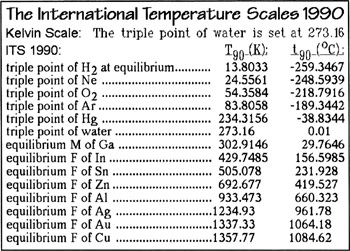 Figure A.8.1
 Besides values for the fixed point temperatures, the ITS 1990 provides also for the maintenance of the temperatures between the given fixed points. The most important temperature range for thermal analysis reaches from about 13 to 1235 K. It is based...
Copyright Springer-Verlag Berlin Heidelberg 2005 under license agreement with Books24x7


 TABLE OF CONTENTS