Thermal Analysis of Polymeric Materials

4.1: Thermometry and Dilatometry

4.1 Thermometry and Dilatometry

4.1.1 Principle and History of Thermometry

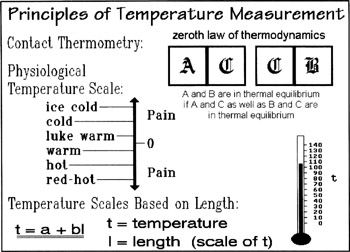
The most common method of temperature measurement is contact thermometry, as demonstrated in Fig. 4.1. One brings a thermometer, C, a system with a known thermal property, into intimate contact with the to be measured system, A. Next, thermal equilibration is awaited. When reached, the temperatures of A and C are equal. The use of C as a contact thermometer is based on the fact that if the two systems A and B are in thermal equilibrium with C they must also be in thermal equilibrium with each other. This statement is sometimes called the zeroth law of thermodynamics. It permits to use B with a known temperature to calibrate C, and then use C for measurement of the temperature of system A. A calibration with B can be made at a fixed temperature of a phase transition without degree of freedom, as given by the phase rule of Sect. 2.5.7. Less common are methods of temperature measurement without a separate thermometer system. They make use of the sample itself. For example, the temperature of the sample can be determined from its length, the speed of sound within the sample, or the frequency of light emitted.


Figure 4.1

Everyone is born with the ability to recognize temperature by contact through the degree of pain. No pain feels comfortable. This is the zero of the physiological temperature scale of Fig. 4.1. Cold and ice-cold show increasing degrees of pain in one...

UNLIMITED FREE
ACCESS
TO THE WORLD'S BEST IDEAS

SUBMIT
Already a GlobalSpec user? Log in.

This is embarrasing...

An error occurred while processing the form. Please try again in a few minutes.

Customize Your GlobalSpec Experience

Category: Infrared Thermometers
Finish!
Privacy Policy

This is embarrasing...

An error occurred while processing the form. Please try again in a few minutes.