The turbidity, ?, expressed in m ?1, is a measure of the total intensity of light, I, scattered in all directions from an incoming beam of intensity I o. A typical data table and the mathematical equation are shown in Fig. A.3.1, where ? is the distance traversed by the incoming light within the scattering medium. Also given is the competing Raman scattering, which represents the scattered light of changed wavelengths, in contrast to the here described Rayleigh scattering with an unchanged wavelength. The scattering of light increases by a factor 100,000 in going from a clear crystal, such as quartz, to a 1% polymer solution, i.e., the Raman intensity originating from the polymer is negligible relative to the Rayleigh scattering.
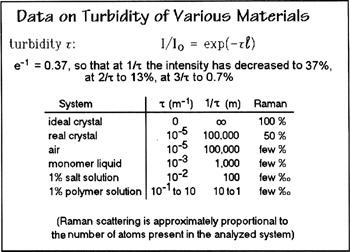 Figure A.3.1
 In Fig. A.3.2 the two basic proportionalities describing light scattering are added to the turbidity equation. They concern the electric moment, p, induced in the scattering center, and the amplitude of the scattered light. The scattering center is initially assumed to be of negligible size, i.e., < ?/20. The polarizability is given the symbol ?, and E o is the electric field strength of the incoming light. The light is characterized by its speed in vacuum, c = 2.998 10 5 km s ?1, and its wavelength is ?, the wavelengths of visible light = 400-750 nm. The amplitude of the scattered light, s, is recorded at a distance r, and the angle ? z from the...
Copyright Springer-Verlag Berlin Heidelberg 2005 under license agreement with Books24x7


 TABLE OF CONTENTS