Thermal Analysis of Polymeric Materials

4.6: Thermogravimetry

4.6 Thermogravimetry

4.6.1 Principle and History

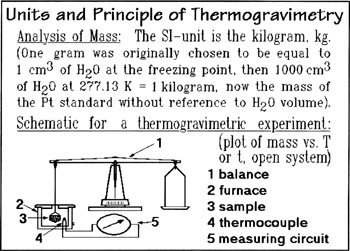
The additional variable of state for thermal analysis by thermogravimetry is mass, as suggested in Fig. 4.175. The SI unit of mass is the kilogram [kg], which is the mass of an international prototype in form of a platinum cylinder and is kept at the International Bureau of Weights and Measures near Paris, France (see also Fig. 2.3). The last adjustment was made for the 1990 SI scale. Originally, that is in 1795, the gram was chosen as mass standard. It was to represent the mass of 1 cm 3 of H 2O at its freezing temperature. In 1799 the mass standard was changed to 1,000 cm 3 of water at its maximum of density at 277.13 K, since the larger mass could be measured more precisely. At present, this connection is only approximate, but the difference from the old size is hardly noticeable for practical applications. Today the mass standard is independent of the volume of water.


Figure 4.175

The basic mass determination is simple. It consists in a comparison of the force exerted by gravity on the two masses to be compared, using for example a beam balance as is shown schematically in Fig. 4.175. For practically all thermal analyses, changes in temperature, pressure, volume, or chemical bonding do not change the total mass. The main calculation from a direct measurement of mass is to establish the number of moles of the compound or element in question. This is...

UNLIMITED FREE
ACCESS
TO THE WORLD'S BEST IDEAS

SUBMIT
Already a GlobalSpec user? Log in.

This is embarrasing...

An error occurred while processing the form. Please try again in a few minutes.

Customize Your GlobalSpec Experience

Category: Calibration and Test Weights
Finish!
Privacy Policy

This is embarrasing...

An error occurred while processing the form. Please try again in a few minutes.