Bistatic Radar, 2nd Edition

Chapter 6: Doppler Relationships

OVERVIEW

A canonical definition of bistatic doppler, or doppler shift, f B, ignoring relativistic effects, is the time rate of change of the total path length of the scattered signal, normalized by the wavelength ? [1]. Because the total path length is the range sum, R T + R R,


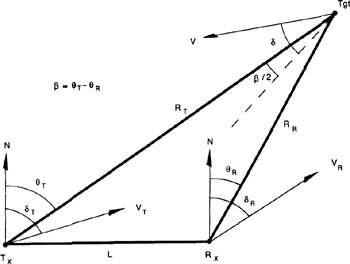
Figure 6.1 defines the geometry and kinematics for bistatic doppler when the target, transmitter, and receiver are moving. The target's velocity vector projected onto the bistatic plane has magnitude V and aspect angle ? referenced to the bistatic bisector. The aspect angle is positive when measured clockwise from the bistatic bisector. The transmitter and receiver have projected velocity vectors of magnitude ? T and ? R and aspect angles ? T and ? R, respectively, per the North-referenced coordinate System of Figure 3.1.


Figure 6.1: Geometry for bistatic doppler

6.1 TARGET DOPPLER

When the transmitter and receiver are stationary ( V T = V R = 0) and the target is moving ( V ? 0), the target's bistatic doppler at the receiver site is developed as follows. The term d R T/d t is the projection of the target velocity vector onto the transmitter-to-target LOS:


where ? and ? are shown in Figure 6.1. Similarly, d R R/d t is the projection of the target velocity vector onto the receiver-to-target LOS:


Combining (6.1b), (6.2), and (6.3) yields


where f Tgt

UNLIMITED FREE
ACCESS
TO THE WORLD'S BEST IDEAS

SUBMIT
Already a GlobalSpec user? Log in.

This is embarrasing...

An error occurred while processing the form. Please try again in a few minutes.

Customize Your GlobalSpec Experience

Category: Speed Logs
Finish!
Privacy Policy

This is embarrasing...

An error occurred while processing the form. Please try again in a few minutes.