Bistatic Radar, 2nd Edition

Bistatic and multistatic radars are subject to problems and special requirements that are either not encountered or encountered in less serious form by monostatic radars. They include beam scan-on-scan coverage losses, with puise chasing as one remedy to recover these losses, increased sidelobe clutter levels, precise time and phase synchronization, and adequate phase stability between transmitter and receiver. Each of these topics is considered in this chapter.
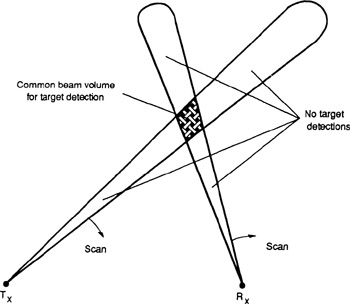
If high-gain narrow-beam scanning antennas are used by both the transmitter and receiver in a bistatic surveillance radar, inefficient use is made of the radar energy beca use only the volume common to both beams can be observed by the receiver at any given time. Targets illuminated by the transmitting beam outside of this volume are lost to the receiver, as are targets outside of this volume but still in the receiving beam. Figure 13.1 shows the geometry. Four remedies can be considered to mitigate the beam scan-on-scan problem: step sean, floodlight beams, multiple simultaneous beams-receivers-signal processors, and time-multiplexed multi-beams-receivers-signal processors, which in the limit is callad pulse chasing. Pulse-chasing requirements are detailed in Section 13.2.
The step sean remedy consists of fixing the transmitting beam position and scanning the receiving beam across the transmitting beam. The transmitting beam is then stepped one beamwidth and the receiving beam sean is repeated, and so forth until the transmitting beam has stepped across the surveillance sector. This remedy increases the...