Bistatic Radar, 2nd Edition

The definition of bistatic target resolution is identical to that of monostatic target resolution: the degree to which two or more targets (of approximately equal amplitude and arbitrary constant phase) may be separated in one or more dimensions, such as angle, range, velocity (or doppler), and acceleration [116, 154]. In the monostatic case, target separation is referenced to the radar-to-target LOS. In the bistatic case, target separation can conveniently be referenced to the bistatic bisector.
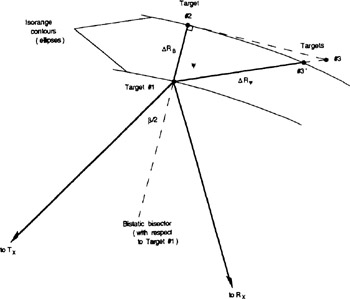
For monostatic and bistatic range resolution, an adequate degree of separation between two target echoes at the receiver is conventionally taken to be c ?/2, where r is the radar's (compressed) pulsewidth [155]. To generate c ?/2 separation at a bistatic receiver, two point-scattering targets, such as targets 1 and 2 in Figure 7.1, must lie on bistatic isorange contours having a separation, ?R B, that is approximately C ?/2 cos( ?/2) (Section 4.6). When a Une joining the two targets is not colinear with the bistatic bisector, but at an aspect angle ? with respect to the bistatic bisector, such as for targets 1 and 3 in Figure 7.1, their physical separation ?R ? must be approximately ?R B/cos ?. Hence,
When (7.1) is satisfied, the projection of ?R ? onto the bistatic bisector satisfied the c ?/2 cos( ?/2) requirement, which, in...