Bistatic Radar, 2nd Edition

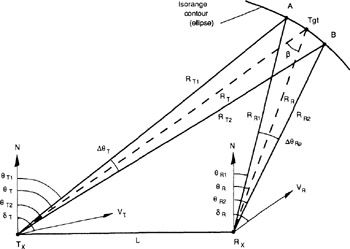
This appendix develops exact and approximate relationships between parameters in target location and clutter doppler spread equations. The parameters are shown in Figure E.1, using the North-referenced coordinate System of Figure 3.1. Because exact relationships are required, the isorange contour must be an ellipse, rather than the tangent approximation (perpendicular to the bistatic angle bisector). Initially, this requirement would seem to be intimidating, but the results are surprisingly tractable when ellipse eccentricity, e, is used in the development.
The isorange contour of interest is defined by an ellipse as
where 2 a is the major axis of the ellipse. Eccentricity of the ellipse, e, is
In all expressions involving e, when the target lies on the baseline, e = 1 and the parameters become indeterminate.
When L, ( R T + R R), and ? R are measured, R R and R T are calculated as follows. From the law of cosines:
and
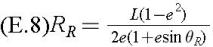
Combining (E.2b) and (E.6) yields
Combining (E.2b) and (E.7) yields
When L, ( R T + R R), and ? T are measured, R R and R T are calculated in a similar manner. From the law of cosines:
and
Combining (E.2b) and (E.1 1) yields
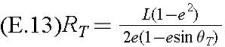
Combining (E.2b) and (E.12) yields
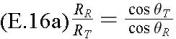
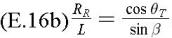
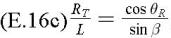
From the law of sines:
Thus,
and
Combining (E.8), (E.13), and...