Bistatic Radar, 2nd Edition

Appendix B: Width of a Bistatic Range Cell

B.1 INTRODUCTION

The width of a bistatic range cell, ? R B, is usually given as [73]


where

c = speed of light,

? = compressed pulsewidth,

? = bistatic angle.

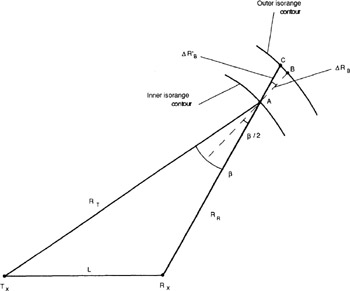
As shown in Figure B.1, ? R B is measured along the bisector of the bistatic angle, line , and the bistatic angle is measured at the intersection of the receiver-to-target LOS and the inner edge of the bistatic range cell, or the smaller of the two confocal ellipses (isorange contours) defining the range cell.

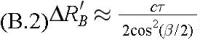
This width can also be defined as


Figure B.1: Geometry for approximation to the width of a bistatic range cell

where ? R ? B is measured along the receiver-to-target LOS, line in Figure B.1. When is approximated as a right triangle, ? R B = ? R ? B cos( ?/2), so that (B.1) and (B.2) are equivalent. Note that c ?/2 = ? R M, the width of a monostatic range cell.

An intuitive explanation of (B.1) and (B.2) is that the bistatic range cell broadens as ? increases from the pseudomonostatic geometry on the extended baseline ( ? = 0, ? R B = ? R ? B = ? R M). This broadening occurs because the separation between two confocal ellipses defining the bistatic range cell increases from a minimum on the extended baseline to a maximum at the point where the...

UNLIMITED FREE
ACCESS
TO THE WORLD'S BEST IDEAS

SUBMIT
Already a GlobalSpec user? Log in.

This is embarrasing...

An error occurred while processing the form. Please try again in a few minutes.

Customize Your GlobalSpec Experience

Category: Color Meters and Appearance Instruments
Finish!
Privacy Policy

This is embarrasing...

An error occurred while processing the form. Please try again in a few minutes.