Bistatic Radar, 2nd Edition

In Chapter 3 it was asserted that (1) at any point on an ellipse the bisector of the bistatic angle is orthogonal to the tangent to the ellipse and (2) the tangents of concentric hyperbolas are orthogonal to tangents of concentric ellipses at their points of intersection, when the hyperbolas and ellipses share common foci. These assertions are frequently made in the bistatic radar literature, but to the author's knowledge, their proofs are either not documented or not conveniently available. This appendix provides proofs to these two orthogonal conic section theorems.
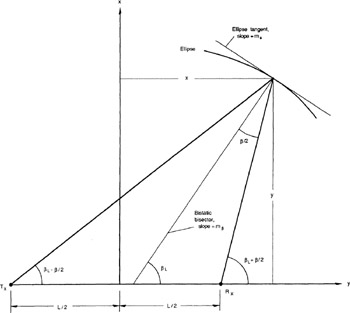
Figure F.1 shows the bisector tangent geometry. The condition for orthogonality is
where m ? is the slope of the bistatic bisector and m e is the slope of the ellipse tangent. Now
and
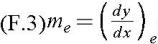
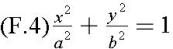
where ? L is the angle between the bistatic bisector and the baseline, as shown in Figure F.1, and (d y/d x) e is the derivative of the equation for an ellipse in rectilinear coordinates, defined in Figure F.1. The equation for an ellipse is
Solving (F.4) for y and differentiating yields
The next step is to express (F.2) in terms of the parameters of (F.5), ( x, a, b), where a is the semimajor axis of the ellipse and b is the semiminor axis of the ellipse, such that
and L is the distance between ellipse foci, or the baseline.
The term...