Digital Signal Processing Using MATLAB and Wavelets
Chapter 6: The Fourier Transform

Overview

Many different fields, including medicine, optics, physics, and electrical engineering, use the Fourier Transform (FT) as a common analysis tool. In practice, the standards by compression groups JPEG (Joint Photographic Experts Group) and MPEG (Motion Picture Experts Group) use a modified form of the Fourier transform. Essentially, it allows us to look at frequency information instead of time information, which people find more natural for some data. For example, many stereo systems have rows of little lights that glow according to the strength of frequency bands. The stronger the treble, for example, the more lights along the row are lit, creating a light bar that rises and falls according to the music. This is the type of information produced by the Fourier transform.

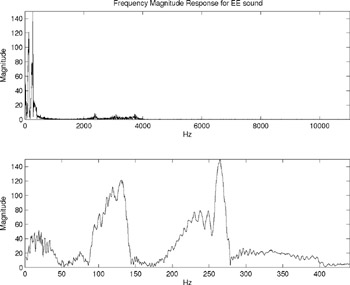
The Discrete Fourier Transform (DFT) is the version of this transform that we will concentrate on, since it works on discrete data. Our data are discrete in time, and we can assume that they are periodic. That is, if we took another N samples they would just be a repeat of the data we already have, in terms of the frequencies present. In this case, we use the DFT, which produces discrete frequency information that we also assume is periodic. Below, in Figure 6.1, we see the frequency magnitude response graph for the "ee" sound. We got this by applying the discrete Fourier transform to the sound file. The figure shows the whole range along the top, and a close-up view on the bottom.


Figure...

UNLIMITED FREE
ACCESS
TO THE WORLD'S BEST IDEAS

SUBMIT
Already a GlobalSpec user? Log in.

This is embarrasing...

An error occurred while processing the form. Please try again in a few minutes.

Customize Your GlobalSpec Experience

Category: Audio Analyzers
Finish!
Privacy Policy

This is embarrasing...

An error occurred while processing the form. Please try again in a few minutes.