Digital Signal Processing Using MATLAB and Wavelets

Euler's formula: so far we have used it like a transform to go from e j to cos() + j sin(), or back. But why can we do this? Where does e come from? What does j really mean? These questions and more will be answered in this chapter. Along the way, we have a few important concepts about DSP, including how a complex number can be thought of as a vector on the complex plane (instead of a real number on the real number line), how such a vector can rotate, how we can go between alternate representations of the same information (such as polar coordinates versus Cartesian ones), and how some representations are more suitable for mathematical manipulations than others.
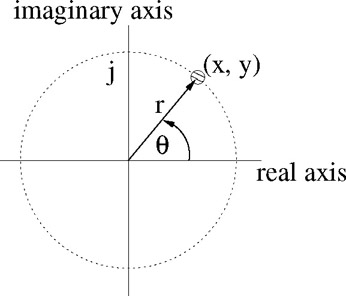
Instead of using the Cartesian coordinate system to map a variable and a function, we can represent a complex number as a point on this plane. Here we have the x-axis represent the "real" part of a complex number, and the y-axis represent the "imaginary" part of it. Of course, we can also think of this same information in terms of polar coordinates; that is, we can represent it as a point ( x, y), or as a vector r ? ? (length and angle), Figure 7.1.
The x-position of the vector is given by the function x = r cos(