Digital Signal Processing Using MATLAB and Wavelets

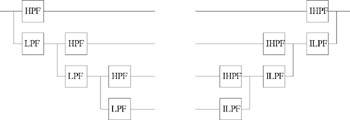
Just as the discrete Fourier transform breaks a signal into sinusoids, the discrete wavelet transform generates "little waves" from a signal. These waves can then be added together to reform the signal. Figure 9.13 shows the wavelet analysis for three octaves on the left, with the standard synthesis (reconstruction) on the right. "LPF" stands for lowpass filter, while "HPF" means highpass filter. The "ILPF" and "IHPF" are the inverse low- and highpass filters, respectively. Although the down-sampling and up-sampling operations are not explicitly shown, they can be included in the filters without loss of generality. On the right, there is an implied addition when two lines meet.
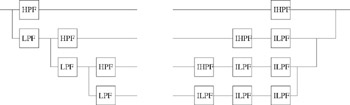
Figure 9.14 shows an alternate way to do the reconstruction. While not as efficient as Figure 9.13, it serves to demonstrate the contribution of each channel.
In the end, we have four signals: three detail signals, and one level-3 approximation.
This section rests on the argument that we can rearrange the operations in the reconstruction, i.e., that we can perform the up-sampling and filtering first, and then do the addition. We know that the ILPF and IHPF are made with FIR filters that have constant filter coefficients and are, therefore, linear. Thus, we know that it does not matter whether we add two signals together and filter their sum, or filter the two then add the results together. But what if we have down and up-samplers...