Electronic and Optoelectronic Properties of Semiconductor Structures

Semiconductors and devices based on them are ubiquitous in every aspect of modern life. From "gameboys" to personal computers, from the brains behind "nintendo" to world wide satellite phones semiconductors contribute to life perhaps like no other manmade material. Silicon and semiconductor have entered the vocabulary of newscasters and stockbrokers. Parents driving their kids cross-country are grudgingly grateful to the "baby-sitting service" provided by ever more complex "gameboys." Cell phones and pagers have suddenly brought modernity to remote villages. "How exciting," some say. "When will it all end?" say others.
The ever expanding world of semiconductors brings new challenges and opportunities to the student of semiconductor physics and devices. Every year brings new materials and structures into the fold of what we call semiconductors. New physical phenomena need to be grasped as structures become ever smaller.
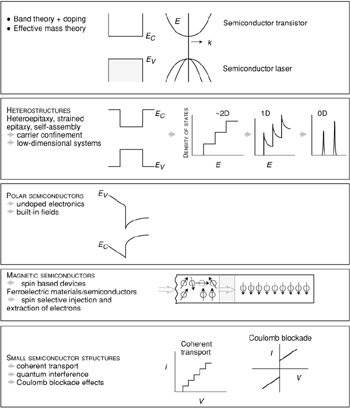
In Fig. I.1 we show an overview of progress in semiconductor physics and devices, since the initial understanding of the band theory in the 1930s. In this text we explore the physics behind all of the features listed in this figure. Let us take a brief look at the topics illustrated.
Band theory: The discovery of quantum mechanics and its application to understand the properties of electrons in crystalline solids has been one of the most important scientific theories. This is especially so when one considers the impact of band theory on...