Electronic and Optoelectronic Properties of Semiconductor Structures

2.6: ORTHOGONALIZED PLANE WAVE METHOD

2.6 ORTHOGONALIZED PLANE WAVE METHOD

We know from quantum mechanics that we can solve the Schr dinger equation by expanding the eigenfunction in terms of a complete basis function and developing a matrix eigenvalue equation. In the tight binding method we have used the atomic functions as a basis set to describe the bandstructure. It is also possible to use a plane wave basis to do so. The plane wave basis is an attractive basis but has difficulty because too many plane waves are needed to describe the problem adequately. To express the equation in plane wave basis we need to use the reciprocal lattices vectors to expand the periodic potential.

The reciprocal lattice vectors G have the property that if R represent the general lattice vector then

(2.57)

and the potential is periodic in R, i.e.,

U( r + R) = U( r)

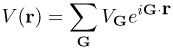
The periodic potential can, in general, be written as

(2.58)

If the potential is short-ranged, a large number of reciprocal lattice vectors are required to describe it. This makes the size of the secular equation to be solved correspondingly large. The orthogonalized plane wave (OPW) method is an approach to avoid having to deal with a very large number of plane wave states. The basic idea is that the valence and conduction band states are orthogonal to the core states of the crystal and this fact should be utilized in the selection of the plane waves. This simple imposition greatly...

UNLIMITED FREE
ACCESS
TO THE WORLD'S BEST IDEAS

SUBMIT
Already a GlobalSpec user? Log in.

This is embarrasing...

An error occurred while processing the form. Please try again in a few minutes.

Customize Your GlobalSpec Experience

Category: Antennas
Finish!
Privacy Policy

This is embarrasing...

An error occurred while processing the form. Please try again in a few minutes.