Electronic and Optoelectronic Properties of Semiconductor Structures

2.11: DOPING: DONORS AND ACCEPTORS

2.11 DOPING: DONORS AND ACCEPTORS

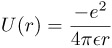
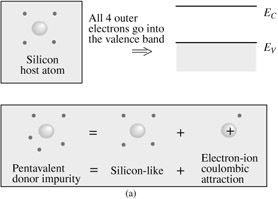
In the last section of this chapter we will discuss electron and hole densities arising from doping. There are two kinds of dopants donors, which donate an electron to the conduction band, and acceptors, which accept an electron from the valence band (thus creating a hole). To understand the donor (or acceptor) problem, we consider a donor atom on a crystal lattice site. The donor atom could be a pentavalent atom in silicon or a Si atom on a Ga site in GaAs. Thus it has one or two extra electrons in its outermost shell compared to the host atom it replaces. Focusing on the pentavalent atom in Si, four of the valence electrons of the donor atom behave as they would in a Si atom; the remaining fifth electron now sees a positively charged ion to which it is attracted, as shown in Fig. 2.23. The ion has a charge of unity and the attraction is simply a Coulombic attraction suppressed by the dielectric constant of the material. The attractive potential is ( e is the dielectric constant of the semiconductor, i.e., the product of ? 0 and the relative dielectric constant)


This problem is now essentially the same as that of an electron in the hydrogen atom problem. The only difference is that the electron mass is m* and the coulombic potential is reduced by ? 0/ ?.


Figure 2.23: A schematic showing the approach to understanding donors in...

UNLIMITED FREE
ACCESS
TO THE WORLD'S BEST IDEAS

SUBMIT
Already a GlobalSpec user? Log in.

This is embarrasing...

An error occurred while processing the form. Please try again in a few minutes.

Customize Your GlobalSpec Experience

Category: Semiconducting Materials
Finish!
Privacy Policy

This is embarrasing...

An error occurred while processing the form. Please try again in a few minutes.