Electronic and Optoelectronic Properties of Semiconductor Structures

Chapter 4: Transport: General Formalism

4.1 INTRODUCTION

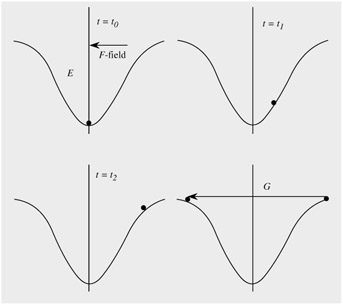
According to Bloch theorem even though an electron sees a complex background potential in a crystal, it suffers no collision during its motion through the structure. The motion of an electron in an electric field is described schematically in Figure 4.1. As shown in Fig. 4.1 electrons will simply follow a band to the Brillouin zone edge and then retrace their trajectory. This produces oscillations called Bloch oscillations which are discussed in Chapter 8. However, in real materials electrons are usually scattered by the presence of various imperfections in the crystal.


Figure 4.1: A schematic of how electrons move in absence of any imperfections in a crystal. An electron gains crystal momentum according to the equation ? dk/ dt = e F. The electron climbs up the band until it reaches a zone edge and in the reduced zone scheme the electron appears as if it has been scattered by a reciprocal lattice vector.

We will now calculate the effects of imperfections on the electron transport. It is important to remember that we use first order perturbation theory which gives us the Fermi golden rule. The rates given by the golden rule are calculated for Bloch states. Very often it is necessary to describe the electron by states that are well-defined in position space as well as momentum space. This is done by the wavepacket description. However, one ignores the uncertainty relation

(4.1)

for the wavepacket. In this quasiclassical treatment the electron is then...

UNLIMITED FREE
ACCESS
TO THE WORLD'S BEST IDEAS

SUBMIT
Already a GlobalSpec user? Log in.

This is embarrasing...

An error occurred while processing the form. Please try again in a few minutes.

Customize Your GlobalSpec Experience

Category: Photovoltaic Cells
Finish!
Privacy Policy

This is embarrasing...

An error occurred while processing the form. Please try again in a few minutes.