Electronic and Optoelectronic Properties of Semiconductor Structures

In this text we have used a number of very important quantum mechanics concepts to understand the electronic and optoelectronic properties of semiconductor structures. While this appendix cannot substitute for a text on quantum mechanics, the reader may find it useful to review concepts he/she has learned. We will review the following problems which are quite useful in semiconductor physics: i) Density of states in bulk and lower dimensional systems; ii) time independent perturbation theory; iii) time dependent perturbation theory and Fermi golden rule; and iv) numerical solution for electronic bound states in an arbitrary shaped quantum well.
We have seen that essentially all properties of semiconductors are related to the density of states. Using the effective mass picture the Schr dinger equation for electrons can be written as a "free' electron problem with a background potential V 0,
| (C.1) | |
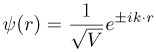
A general solution of this equation is
| (C.2) | |
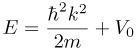
and the corresponding energy is
| (C.3) | |
where the factor
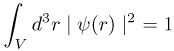
in the wavefunction occurs because we wish to have one particle per volume V or
| (C.4) | |
We assume that the volume V is a cube of side L.
To obtain macroscopic properties independent of the chosen volume V, two kinds of boundary conditions are imposed on the wavefunction. In the first one the wavefunction is considered to go to zero at the boundaries of the volume, as shown in Fig. C.1a. In this case, the wave solutions are standing waves of the form sin(