Electronic and Optoelectronic Properties of Semiconductor Structures

2.2: BLOCH THEOREM AND CRYSTAL MOMENTUM

2.2 BLOCH THEOREM AND CRYSTAL MOMENTUM

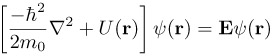
To understand the electronic properties of a material we need to know what the electron wavefunctions and energies are inside a solid. We are only interested in crystalline materials here. The description of electrons in a periodic material has to be via the Schr dinger equation

(2.1)

where U( r) is the background potential seen by the electrons. Due to the crystalline nature of the material, the potential U( r) has the same periodicity, R, as the lattice

(2.2)

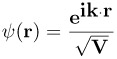
If the background potential is zero, the electronic function in a volume V is


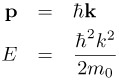
and the electron momentum and energy are


The wavefunction is spread in the entire sample and has equal probability ( ? * ?) at every point in space.

Let us examine the periodic crystal. We expect the electron probability to be same in all unit cells of the crystal because each cell is identical. If the potential was random, this would not be the case, as shown schematically in Fig. 2.1a. If R is a periodic vector of the lattice we expect

?( r) 2 = ?( r + R) 2

If this equality is not solid we would be able to distinguish one unit cell from another. Note that the wavefunction itself is not periodic, it is the probability that is periodic. The wavefunction has to be of a special form described by Bloch's theorem.

UNLIMITED FREE
ACCESS
TO THE WORLD'S BEST IDEAS

SUBMIT
Already a GlobalSpec user? Log in.

This is embarrasing...

An error occurred while processing the form. Please try again in a few minutes.

Customize Your GlobalSpec Experience

Category: Photovoltaic Cells
Finish!
Privacy Policy

This is embarrasing...

An error occurred while processing the form. Please try again in a few minutes.