Fundamentals of Electromagnetic Fields

Including numerous examples with complete, worked-out solutions, this book is designed to present the fundamental concepts of electromagnetic field theory as they relate to modern engineering applications.
 TABLE OF CONTENTS
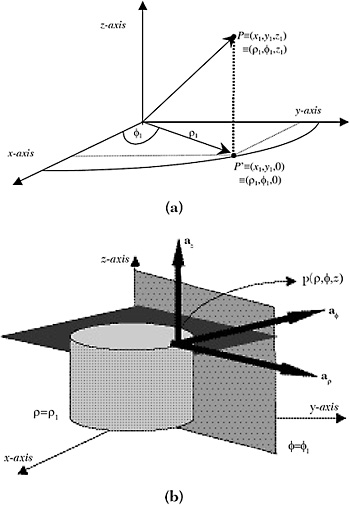
 It would be worth commenting here that, the new coordinate systems that we are going to learn are ones derived from the Cartesian coordinate system. In a three-dimensional Cartesian coordinate system, we represent a point, say, A( x 1, y 1, z 1) as shown in Fig. 1 10. To locate this point, one has to travel a distance x 1 along the x-axis, then y 1 parallel to the y-axis and z 1 parallel to the z-axis. The other way round, if we consider planes x= x 1, y= y 1, and z= z 1, then the intersection of these three planes is the point A( x 1, y 1, z 1) in space. The cylindrical coordinate system is a derived coordinate system in three dimensions, where the required point is at a distance ? 1 from the z-axis in the angular direction  with the x-axis and at z 1 distance from the x- y plane. In other words, the required point is the intersection of three surfaces: Surface 1 which is the locus of all points at a constant distance ?= ? 1 from the z-axis i.e., a right circular cylinder.