Fundamentals of Electromagnetic Fields
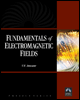
Including numerous examples with complete, worked-out solutions, this book is designed to present the fundamental concepts of electromagnetic field theory as they relate to modern engineering applications.
 TABLE OF CONTENTS
 The Del operator ( ?) is defined as:

This vector operator possesses properties analogous to those of ordinary vectors. It is useful in defining a quantitie s gradient, curl, and divergence by operating ? on a scalar field, and on a vector field by cross and dot product respectively.
Let ?(x,y,z) be a scalar function defined and differentiable at each point (x,y,z) in a certain region in space., i.e., ?(x,y,z) is a differentiable scalar field. Then, the gradient of ?(x,y,z) is defined as:

Let us have a function of three variables, say, T(x,y,z) that represents temperature in a room at point (x,y,z). Then, its derivative is supposed to tell us how fast the temperature (function) varies with position coordinates. But, it is not as simple as it seems to be since it is important to know the direction in which one moves. Here, one has to consider the rate of change of temperature T along different directions i.e., a x, a y, and a z. A known theorem on partial derivatives simply represents rate of change of T(x,y,z) as:

The above equation tells us how fast T changes when we alter all three variables by infinitesimal small amounts dx, dy, and dz. Writing the above equation in a more convenient way as following where the relation is reminiscent...