Fundamentals of Electromagnetic Fields
Including numerous examples with complete, worked-out solutions, this book is designed to present the fundamental concepts of electromagnetic field theory as they relate to modern engineering applications.
 TABLE OF CONTENTS
In 1837, Michel Faraday reported an experiment on the displacement flux, which is sometimes referred to as electric flux or simply flux. In his famous experiment, he considered a conducting sphere of radius a charged + Q Coulombs. This charged sphere is surrounded by another sphere of a little larger radius, say, b. For the purpose of practical feasibility it may be mentioned here that the outer sphere is made up of two hemispheres clamped together to enclose the inner concentric sphere of radius a (as shown in Fig. 3.1) with the dielectric material filled in between the shells.
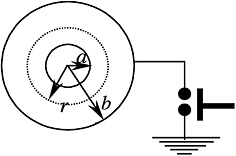
Then, if the outer sphere is momentarily connected to the ground, it is observed that a negative charge of ?Q coulombs is induced on the outer sphere irrespective of the dielectric medium used between the spherical shells. In analyzing the result of this experiment, Faraday commented that there must be some displacement electric flux from the inner sphere of radius a to the outer sphere of radius b due to which the same amount of charge is induced on the outer sphere with opposite polarity. If the primary charge i.e., +Q is increased; the induced charge ?Q on the outer sphere also increases. This clearly indicates that the displacement flux increases to cause increased induction. Therefore, the displacement flux ( ?) is directly proportional...