Fundamentals of Electromagnetic Fields

Including numerous examples with complete, worked-out solutions, this book is designed to present the fundamental concepts of electromagnetic field theory as they relate to modern engineering applications.
 TABLE OF CONTENTS
 We have Maxwell s equation

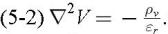
The above equation is referred as Poisson s equation. If we have knowledge of a potential field, with the aid of Poisson s equation we can find the density of charge causing the field. The above equation is derived for free space. It may be modified for a dielectric medium having relative permittivity ? r as in the following:
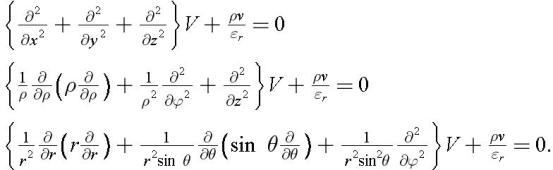
Poisson s equation may be expressed in Cartesian, cylindrical, and spherical coordinates, respectively as in the following:
Thus, we can find the density of charge for the known potential field.
E-1 Let, the potential field V=V o ? cos 2  . Find the potential and density of charge at point P(1, 2, 3).
Solution
The potential at point P( x=1, y=2, z=3) ?( ?=2.23, =63.43, z=3) can be obtained just by substituting the coordinates of point P in the scalar potential field;

We have, 

From Maxwell s equation, we have

In certain problems, the charges are not uniformly or not continuously distributed through the space. Rather, the field is due to some kind of distribution present at one location only For example, the roof of a room is carrying a surface charge density so that field will exist everywhere inside the room. Now consider some random region of space that is not touching the roof. The volume charge density in that region is zero but the field is nonzero. Now, in such...