Fundamentals of Electromagnetic Fields
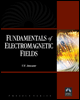
Including numerous examples with complete, worked-out solutions, this book is designed to present the fundamental concepts of electromagnetic field theory as they relate to modern engineering applications.
 TABLE OF CONTENTS
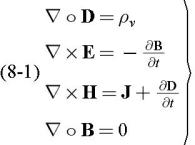
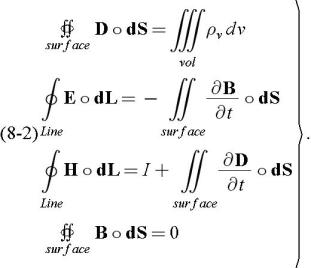
 We have Maxwell s equations for time-varying fields in point form and integral form as follows:
To express wave motion in free space (i.e., vacuum is characterized by permeability o, permittivity ? o and volume charge density ? ?=0), we shall write the Maxwell equations for time-varying fields in the medium where free charges are absent and express them in terms of intensity of electric and magnetic field as:
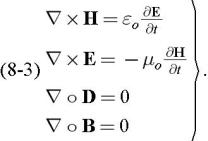
The first equation in the set (8 3) states that, if electric field intensity E is changing with time, the magnetic field intensity H has curl at that point and can be considered as forming small closed loops linking the changing electric field. At the same time, the second equation suggests that if H is changing with time, E will also change with time although not necessarily in the same way
The second equation suggests that time-varying H produces an electric field E that forms small closed loops about H lines. We now have a changing electric field agreeing to our original hypothesis but this field is present at some distance away from the point of original presence.
From these four equations the wave motion can be inferred. And we might guess (correctly) from the above discussion that this time-varying electric and magnetic disturbance travels (propagates) in space and the effect moves with the velocity of light. But this inference needs to be checked by following quantitative discussions.