Fundamentals of Electromagnetic Fields

Including numerous examples with complete, worked-out solutions, this book is designed to present the fundamental concepts of electromagnetic field theory as they relate to modern engineering applications.
 TABLE OF CONTENTS
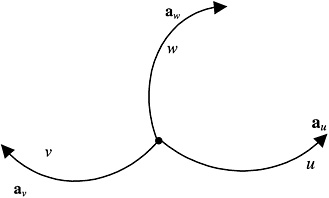
 Consider a generalized curvilinear coordinate system in which a point will be located by the construction of three mutually perpendicular surfaces. (Here the shape of the surfaces is unspecified with a view of generalized representation and then to specified, say, spherical or cylindrical or the most simple Cartesian coordinate system.)
The equation of such surfaces may be given as: u=constant, ?= constant, w=constant. If each variable is increased by a differential amount and three more mutually perpendicular surfaces are drawn, a differential volume element is formed. The smaller the increment considered for forming differential volume element, the closer it will be to the parallelepiped. But in all the cases u, ?, and w will not necessarily be in the length dimension. That is, in the case of cylindrical coordinates, ? represents angle while in spherical coordinates ? and w both are angles. So, each must be multiplied by some factor so that it is converted in the dimension of length where it represents the differential side of a parallelepiped. Therefore, we define scalar factors h 1 , h 2 , h 3 each a function of three variables u, ?, w and write lengths of differential volume element.

In the present case, the evaluation of scalar factors h 1 , h 2 , and h 3 is restricted to Cartesian, cylindrical, and spherical...