Fundamentals of Electromagnetic Fields
Including numerous examples with complete, worked-out solutions, this book is designed to present the fundamental concepts of electromagnetic field theory as they relate to modern engineering applications.
 TABLE OF CONTENTS
 A French army engineer, Colonel Charles Coulomb performed a series of experiments and established a law concerning the force of attraction (among unlike charges) and repulsion (among like charges) that has a great resemblance with Newton s law of gravitation.
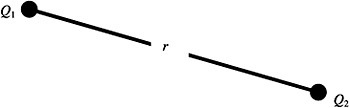
According to Coulomb, the force of attraction or repulsion between two unlike or like charges ( Q 1 and Q 2 as shown in Fig. 2 1) is directly proportional to the product of charges and inversely proportional to the square of the distance r separating them. Moreover, as regards the direction, Coulomb has commented that there exists an attractive/repulsive force for unlike/like charges along the line joining them.
Mathematically, it can be quoted that,

is the constant of proportionality.
?o is known as permittivity for free space i.e., for vacuum; its value is 8.85 ?10 12 F/m, the dimensions of which can be obtained from equation (2 #x2013;1) as C 2/N-m 2. If both the charges are like (i.e., positive-positive or negative-negative) then there exists a repulsive force tending to displace each other away along the line joining them.
On the other hand, if charges are unlike (i.e., positive-negative), then there exists an attractive force tending to displace them toward each other along the line joining them. Now, let us represent the problem in vector notations.
Let the charge Q 1 be placed at...