Fundamentals of Electromagnetic Fields
Including numerous examples with complete, worked-out solutions, this book is designed to present the fundamental concepts of electromagnetic field theory as they relate to modern engineering applications.
 TABLE OF CONTENTS
 Let us have two conductors A and B hanging from a ceiling, carrying current I as shown in Fig. 6 1. In the first case, let the current flow in opposite directions. For a significant current, it is observed that it causes the two conductors to attract each other, pulling the flexible conductors to move closer. As they re tied at the end point, they come close at the central portion. On the other hand, if we allow the current to flow in the same direction, the conductors repel each other, pulling them apart.
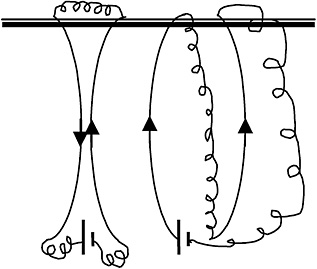
This indicates the existence of some of the field around it. Now, if we place a test charge + Q in a close proximity, it does not experience any force. Hence, the field is definitely not an electrostatic field. This is a field created by charges in motion and called a magnetic field. Moreover, it can be concluded that it does not cause any force on a static charge.
A current-carrying conductor produces the magnetic field, which is expressed by Biot-Savart s law as the following:
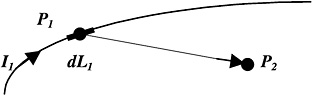
Let I 1 be the current flowing through an infinitely small conductor dL 1 placed at point P 1 . This causes a magnetic field at point P 2 expressed as

Again, it is impossible to...