Advanced Production Testing of RF, SoC and SiP Devices
One of the most frequently used methods to describe the functionality of RF devices is to use scattering parameters, or in short S-parameters. S-parameters are used to describe how a device alters voltage waves that are applied to its ports. For instance, an amplifier should increase the amplitude of the voltage wave that was applied to the input of the device. Therefore, the S-parameter measurement of an amplifier's gain compares the output amplitude of the amplifier to the amplitude of the voltage wave that was applied to stimulate the amplifier.
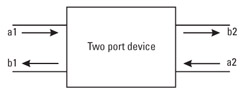
First, let's look into how S-parameters are defined [1]. Figure 2.1 shows the signals that are applied to obtain S-parameters in the case of a two-port device. When we talk about SoC testing, in most cases we are talking about two-port devices, that is, devices in which we observe one output relative to one input. The simplest example of an active two-port device would be an amplifier. The a1 signal in Figure 2.1 is the voltage wave that is applied to the input of the device. Likewise, the a2 signal is a voltage wave that is applied to the output of the device; b1 is the voltage wave that can be measured at the input of the device; and b2 is the voltage wave that can be measured at the output of the device.