Advanced Production Testing of RF, SoC and SiP Devices
Phase noise is a parameter that measures the spectral purity of a signal. It is particularly referenced to a sinusoidal, or CW, waveform. It is associated with the term jitter. The principal difference between the two is that jitter is a property described best by relating it to the time domain, whereas phase noise is best described when related to the frequency domain.
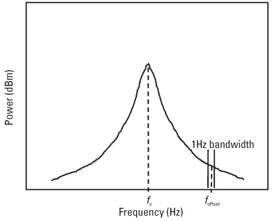
When viewing a pure sine wave in the frequency domain, it will look like an impulse function with all of the energy concentrated at exactly the carrier frequency. In reality, if the frequency space around the carrier frequency is explored, there will be energy located at the adjacent frequencies. This energy is due mostly to phase noise. Its behavior is that of 1/ f noise.
In practice, phase noise is represented in the frequency domain as shown in Figure 4.9. It measures the spectrum of phase deviation. This is its most common representation, as a single-sideband power measurement in a 1-Hz band-width, at some frequency away from, but relative to, a carrier power. For example, a phase noise specification for a VCO on a SoC device might look like this:
which means that the measured power, in a 1-Hz bandwidth, at 10 kHz away from a carrier signal, is 90 dB lower than the...