Advanced Production Testing of RF, SoC and SiP Devices
4.2: Noise Figure

4.2 Noise Figure

4.2.1 Noise Figure Definition

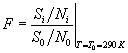
Sensitivity (often synonymous with signal-to-noise ratio) in wireless device receiver front ends is extremely important, because it enables detection and resolution of the weak signals (levels at or below -90 dBm) commonly used in communications and personal/local networks. A term called noise factor, or F, has been defined to quantify the impact a device has on the signal-to-noise ratio:

(4.9)

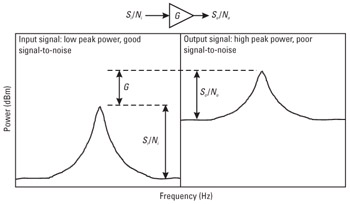
This equation states that noise factor is the ratio of input signal-to-noise ratio to output signal-to-noise ratio at T = T 0, commonly accepted to be 290K (room temperature) [6]. In words, noise factor is the degradation of the signal-to-noise ratio at T 0. It is well known, however, that the magnitude of degradation is difficult to measure directly. Figure 4.5 depicts (4.9) showing the input power level of an amplifier (DUT) and the increased noise at the output of the amplifier resulting in a decreased signal-to-noise ratio. Note that the signal power is higher at the amplifier's output than that of the signal before entering the amplifier. However, because the amplifier adds noise (via the mechanisms described earlier in this chapter) the noise floor at the output is raised significantly. Thus, the signal-to-noise ratio at the output is less than that of the input.


Figure 4.5: Signal-to-noise degradation of a signal passing through a semiconductor device.

The figure of merit, noise figure (NF), is used more readily throughout the industry. Noise figure is simply noise factor in units...

UNLIMITED FREE
ACCESS
TO THE WORLD'S BEST IDEAS

SUBMIT
Already a GlobalSpec user? Log in.

This is embarrasing...

An error occurred while processing the form. Please try again in a few minutes.

Customize Your GlobalSpec Experience

Category: Noise Figure Meters
Finish!
Privacy Policy

This is embarrasing...

An error occurred while processing the form. Please try again in a few minutes.