Advanced Production Testing of RF, SoC and SiP Devices

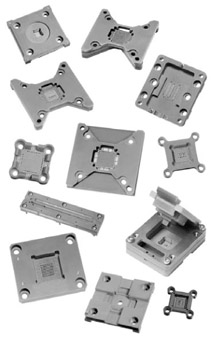
Contactors, or test sockets, [1] as shown in Figure 9.1 are the interface between the DUT and load board and are often the most critical element of the production test solution. They come in many shapes and sizes. The contactor is relatively small in size compared to the rest of the hardware, but infinitely large in value. There have been numerous cases where more than a million dollars worth of production ATE and handler equipment has been interfaced to an expensive load board only to have a poorly designed contactor weaken the entire setup. Compounding this issue is that the redesign of a contactor can require weeks, which can reduce any possibilities of meeting time-to-market goals [1].
Contactors are the link between the DUT and the rest of the test system, as shown in Figure 9.2. Physically, they sit atop the load board. The load board routes signals to and from the test system, so the contactor can be considered an extension of the load board, routing signals between the load board and DUT. Contactors perform the important task of providing a test site for the device in order for the critical performance characteristics of the device to be transferred to the test system. This information, ultimately, determines whether the device passes or fails. In addition, depending on the capabilities of the contactor, it may help determine "how good" the...