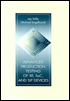
Advanced Production Testing of RF, SoC and SiP Devices
Chapter 8: Calibration

8.1 Overview

All measurements that are performed on any kind of equipment have errors due to inaccuracies in the measurement technique as well as the equipment itself. The purpose of calibration is to reduce (or in theory eliminate) the measurement error that is related to the measurement equipment.

Two types of errors contribute to measurement errors: random errors and systemic errors. Random errors can only be characterized with probabilities and means of statistics. A good example of random error is the contribution of thermal noise. Unless the measurement is executed at absolute zero (0K), there is always a contribution of thermal noise to the measurement. Repeating the same measurement over and over will yield very similar results, plus or minus the random contribution of the noise. Obviously, random errors cannot be calibrated out due to the fact that they are random. The test engineer, however, will have to consider the effects of random error when he or she evaluates the results of a measurement.

The other contributors to errors in a measurement are systemic errors. Systemic errors can be corrected for because it is possible to characterize the exact amount of their contribution to a measurement. For instance, when an RF measurement is performed, the loss between the test head and the digitizer is always the same for one specific frequency and therefore can be calculated out of the measurement result. Assuming that the measured RF power (without calibration) is -8.5 dBm at 1.8 GHz and the loss between the...

UNLIMITED FREE
ACCESS
TO THE WORLD'S BEST IDEAS

SUBMIT
Already a GlobalSpec user? Log in.

This is embarrasing...

An error occurred while processing the form. Please try again in a few minutes.

Customize Your GlobalSpec Experience

Category: Noise Figure Meters
Finish!
Privacy Policy

This is embarrasing...

An error occurred while processing the form. Please try again in a few minutes.