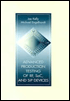
Advanced Production Testing of RF, SoC and SiP Devices
More and more semiconductor manufacturers are trying to implement full coverage of their SoC devices on the wafer level. The latest trends in this industry have forced many companies to implement this technology despite the fact that it is relatively expensive and demanding from an engineering point of view.
Previously, most companies just did some dc probing to check the basic functionality of a die. In many cases the yield of a wafer was high enough to justify skipping any probing. It was more cost effective to package a couple of bad parts that were later filtered out during final testing. However, some manufacturers ship bare die to their customers and those customers are typically not willing to accept any failure rates of their own products due to untested components. This requirement lead to the known-good die (KGD) approach. Also, complete modules are increasingly becoming the standard where several dies and passive components such as filters are built into a single package. This technology is also known as a multichip module (MCM) [1] [1, 2]. In this case, it is getting more and more critical to ensure that all components are functional before the module is built.
[1]The technological development beyond multichip modules is called system in a package or SiP. Even though the idea is similar (i.e., combining various active or passive components into one package), SiPs push the limit further by implementing a complete system into one package. For a Bluetooth SiP,...