The dBm unit is decibels relative to 1 milliwatt. To obtain a dBm value from a value of power in milliwatts, use the following equation:
| (A.1) | 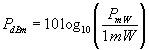
|
To obtain power in watts from a power level specified in dBm, use the following equation:
| (A.2) | 
|
The dBW unit is decibels relative to 1 watt. To obtain a dBW value from a value of power in watts, use the following equation:
| (A.3) | 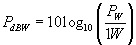
|
Note that (A.1), (A.2), and (A.3) are independent of characteristic impedance ( Z 0), hence, they will work for any impedance.
If P w, is broken down into its constituents, then
| (A.4) | 
|
Placing (A.4) into (A.2), we arrive at the relationship between voltage and dBm. Note that it is dependent on Z 0 :
| (A.5) | 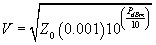
|
Often, for cable TV applications an impedance-dependent unit called V dBmV is used. It is defined as
| (A.6) | 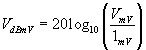
|
The argument of the log 10( ) function is actually a voltage ratio, but the decibel concept was originally defined for power. Because power is defined as V 2/ R, the V 2 term gives rise to the logarithmic multiplier of 20: 10 log( X 2) = 20 log( X).
Also,
| (A.7) | 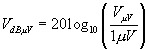
|
Substituting (A.5) into (A.6), the following relationship is found:
| (A.8) | 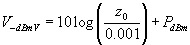
|
For a 50- ? device or circuit,
| (A.9) | 
|
For a 75- ? device or circuit,
| (A.10) | 
|
Tables A.1 and A.2 are a means to demonstrate the relationships of the various power and voltage...
Copyright ARTECH HOUSE, INC. 2007 under license agreement with Books24x7

 TABLE OF CONTENTS