Introduction to Electronic Warfare Modeling and Simulation
EW is the art and science of denying enemy forces the use of the electromagnetic spectrum while preserving its use for friendly forces. EW is a significant force multiplier because it reduces friendly losses by defeating or reducing the effectiveness of enemy weapons.
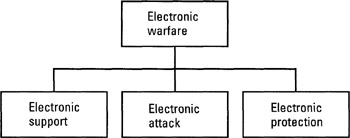
As shown in Figure 2.1, EW is commonly divided into three subfields. Electronic support (ES) involves receiving enemy signals to identify and locate threat emitters and to help determine the enemy's force structure and deployment. Electronic attack (EA) involves measures taken to defeat enemy electronic assets. It includes jamming, chaff and flares, directed energy weapons, and antiradiation missiles. Electronic protection (EP) comprises countermeasures to enemy electronic attack. All of these subfields apply at radar, communication, infrared, and laser operating frequencies.
This chapter deals with the signals, equipment, deployment, and tactics associated with all aspects of EW. As indicated by the chapter title, this discussion provides an overview of EW. It is limited to providing enough information to support our later discussion of EW modeling and simulation, and focuses primarily on the aspects important to modeling and simulation. The following books are recommended to provide the reader with more depth and breadth in the field:
David Adamy. EW101: A First Course in Electronic Warfare. Norwood, MA: Artech House, 2001 (www.artechhouse.com);
David B. Hoisington. Electronic Warfare. Monterey, CA: Naval Postgraduate School, 1980 (available from Lynx Publishing at www.lynxpub.com);
D. Curtis Schleher. Introduction to Electronic Warfare. Norwood, MA: Artech House, 1986;