Introduction to Electronic Warfare Modeling and Simulation
Radar was developed to detect and track aircraft and ships so that they could be attacked. Now there are a wide variety of radars for both peaceful and warlike purposes. For example, radars track aircraft for air-traffic control, determine weather conditions, map ground contours, track ships or surface vehicles, and detect people moving over terrain.
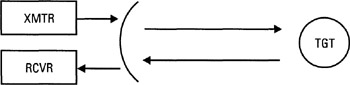
A radar has both a transmitter and a receiver. The transmitted signal is reflected by anything it strikes and those reflected signals are received and processed. The transmitter and receiver are usually (but not necessarily) allocated, and may share a common antenna. Figure 2.2 shows the function of a simple radar.
The transmitter (XMTR) transmits a signal to a common antenna (a parabolic dish is very typical). The antenna is almost always highly directional so that the transmitted signal is constrained to a narrow angular segment (called the beam width) so that it illuminates only a single target (TGT). In Section 5.1, the various types of antennas and their characteristics will be discussed in detail. Since the receiver (RCVR) uses the same antenna, it receives reflections in its main beam from the illuminated target. The azimuth and elevation angle of the antenna is known, so the angular location of the target can be readily determined.
The distance to the target is determined by measuring the time between the transmission of the signal and the reception of the signal reflected from the target. Since...