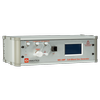
Simulation for T&E is used to test equipment under realistic signal environmental conditions. A standard piece of test equipment can be used to generate any type of signal. However, EW systems need to operate in the presence of a full signal environment, which usually contains many signals. But even with an unaffordable room full of single signal generators, you would still need to coordinate their operation to simulate the effects of a real-world military signal environment. T&E simulators provide that environment, in some appropriate form, to test receivers, subsystems, and whole systems.
In general, the frequency and location of the EW signal that must be received and processed in a limited amount of time is not known. Searching for that signal is made much more difficult by the presence of many similar signals that must be evaluated and rejected in some way. Hence, the T&E simulator tests the ability of both hardware and software to do their advertised job.
T&E simulators are by definition emulators. Since emulation is the subject of Chapter 10, it will not be specifically discussed here. The important issues related to T&E simulation are fidelity, entry points, and operator involvement.
Since T&E simulators are, in effect, specialized test equipment, they must support accurate testing. This means that they must not pollute the test data with test equipment inaccuracies. The general rule is that the simulator fidelity must be 10 dB better than the specifications to which the evaluated equipment is being tested. There are some circumstances...
Copyright SciTech Publishing, Inc. 2006 under license agreement with Books24x7

 TABLE OF CONTENTS