Introduction to Electronic Warfare Modeling and Simulation
Decoys have two classic military applications. The first is to hide important friendly assets among a large number of decoys. The second is to cause an enemy to waste valuable weapons to destroy a low-value decoy. There are now two more important decoy missions: to cause an enemy to expose his defensive assets and to lure a guided weapon away from a protected friendly asset. In any of these applications, it is important that the enemy not be able to easily distinguish the decoy from the real thing.
Let us focus on applications involving the hostile electronic-tracking of friendly assets. In these cases, the decoy must provide the same return signal that would be produced by the skin return from the protected asset. Since decoys are typically smaller than the assets they protect, they must be made extremely efficient reflectors to produce large RCS in small physical space. This is accomplished passively by use of corner reflectors. A corner reflector returns up to 100 times as much energy (back toward the radar) as a cylinder of the same size.
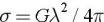
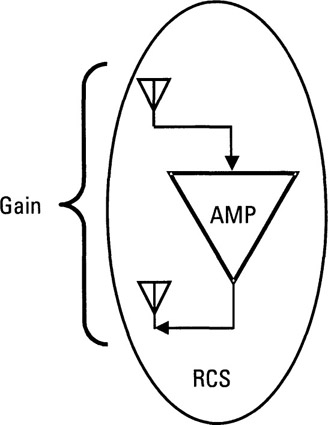
Active electronic decoys can create enhanced RCS by amplifying received signals and retransmitting them back to the radar, as shown in Figure 2.51. The gain is related to the RCS by the following formula:
where
? = the RCS;
? = the radar wavelength;
G = the decoy gain (combined antenna and amplifier gains).
We will use a different form...