Introduction to Electronic Warfare Modeling and Simulation
Electronic attack (EA) is the action part of EW. When ES finds out what is going on, EA does something about it. EA includes electronic countermea-sures (ECM) and two other activities that were not previously considered part of EW. These are directed-energy weapons (DEW) and antiradiation missiles (ARM). We will first focus on jamming, then on the other portions of the field.
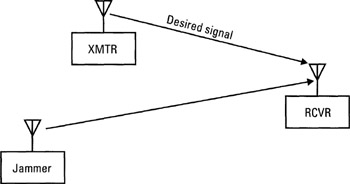
Figure 2.35 shows the basic jamming concept. Note that you always jam the receiver not the transmitter. Jamming involves placing a signal into the receiver that interferes with the reception or processing of the desired signal. The confusion about jamming the transmitter comes from the fact that a monostatic radar has its transmitter and receiver in the same place.
Figure 2.36 shows the radar-jamming concept. The jammer places a signal into the radar receiver that interferes with the reception or processing of the reflected signals returning from the target. For bistatic radar, you need to put the jamming signal into the receiver location.
We will classify jamming by type of threat signal (radar versus communication), by jamming geometry (standoff versus self-protection versus expendable), and by jamming technique (cover versus deceptive versus decoy). While it is somewhat controversial to include decoys as a type of jamming, they act a lot like jammers and their performance is calculated using some of the same equations.
Radar versus communication jamming is an easy distinction. Each attempts to interfere with...