Ion Implantation and Synthesis of Materials

Chapter 2: Particle Interactions

2.1 Introduction

The manner in which the potential energy of a two-particle system varies with the distance separating the two centers determines both the equilibrium properties of an assembly of atoms and the way that energetic particles interact with a lattice of stationary atoms. The scattering probability of an ion-atom collision is intimately related to the interaction forces between atoms.

2.2 Interatomic Forces

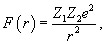
We start our discussion with the concept that atoms are comprised of a central nucleus and orbital electrons, and we consider the forces when one atom interacts with another atom. The nucleus is effectively a solid body of diameter ~10 -12 cm with a positive charge, Z, which is dependent on the number of protons present. If there were no orbital electrons, the force between two nuclei separated by a distance r would be Coulombic, of the form

(2.1)

where Z 1 and Z 2 are the numbers of protons contained in the nucleus, and e 2 = 1.44 eV nm (1.8).

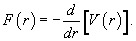
For most purposes, the force between two atoms is expressed in terms of an interatomic potential, which depends primarily on the separation, r, between the atoms or other charged particles. If the dependence of the potential on other coordinates is neglected (central force approximation), then the force, F( r), and the potential, V( r), are related by

(2.2)

The restriction to r-dependence is usually a good approximation. Throughout this text, the variable r

UNLIMITED FREE
ACCESS
TO THE WORLD'S BEST IDEAS

SUBMIT
Already a GlobalSpec user? Log in.

This is embarrasing...

An error occurred while processing the form. Please try again in a few minutes.

Customize Your GlobalSpec Experience

Category: Radiation Detectors
Finish!
Privacy Policy

This is embarrasing...

An error occurred while processing the form. Please try again in a few minutes.