Ion Implantation and Synthesis of Materials

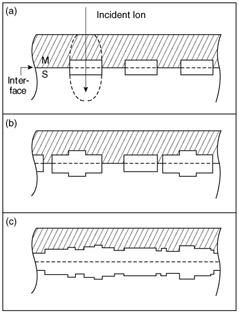
Materials under ion irradiation undergo significant atomic rearrangement. The most obvious example of this phenomenon is the atomic intermixing and alloying that can occur at the interface separating two different materials during ion irradiation. This process is known as ion beam mixing. An early observation of the ion mixing phenomenon was made following the irradiation of a Si substrate coated with a thin Pd film. A reaction between Pd and Si was observed when the irradiating Ar ions had sufficient energy to penetrate through the Pd/Si interface (van der Weg et al. 1974). This process is schematically displayed in Fig. 13.1 for a layer M on a substrate S for successively higher irradiation doses.
Early in the irradiation, when ion tracks are well isolated, each incident ion initiates a collision cascade surrounding the ion track. Atoms within the cascade volume will be mobile and undergo rearrangement for a short period of time, resulting in an intermixed region near the interface. At this stage of the ion mixing process, the interfacial reaction is considered to be composed of many localized volumes of reaction (Fig. 13.1a). As the irradiation dose is increased, overlap of localized regions occurs (Fig. 13.1b), and for higher doses, a continuous reacted layer is formed at the interface (Fig. 13.1c).
A major driving force in the development of the ion beam mixing process is...